
Fuel Leak: Detect, Isolate, Respond
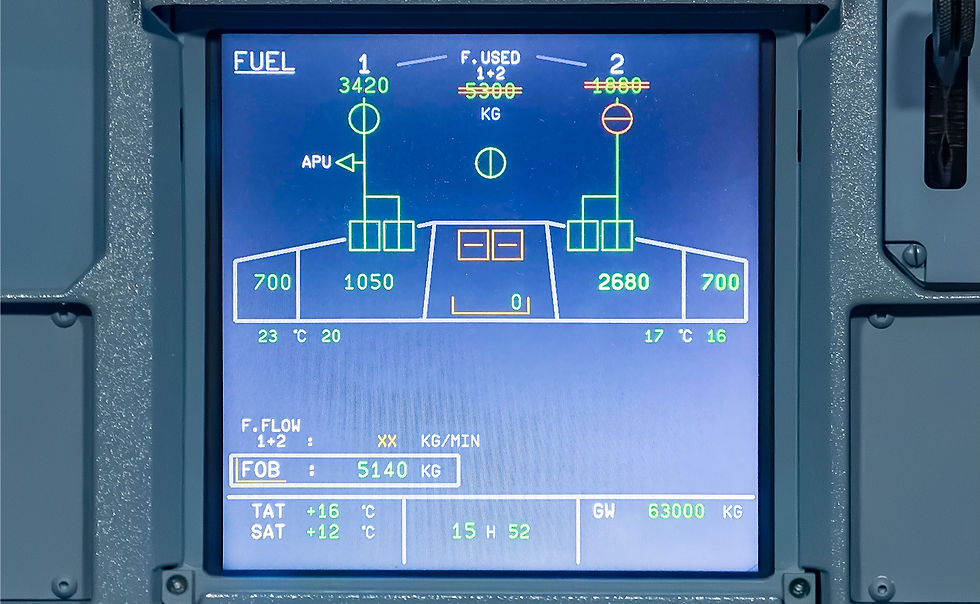
When you're cruising at 37 000 ft with 180 passengers behind you, few things are more concerning than discovering your aircraft is losing fuel. But how do you know when fuel is actually leaking versus normal consumption? What's the difference between a minor seepage and a serious emergency? Understanding fuel leak detection and management isn't just about following procedures—it's about making informed decisions that could determine whether you complete your planned flight or need to divert immediately.
How Fuel Leak Detection Works
The A320/A321 doesn't have dedicated fuel leak sensors scanning the aircraft for dripping fuel. Instead, the system relies on careful fuel accounting—essentially a continuous audit of where every kilogram of fuel should be. This approach works because fuel systems are closed loops where fuel can only go to specific places: the engines, overboard through vents, or remain in tanks.
The fundamental principle is simple: at any point in flight, your current Fuel On Board (FOB) plus Fuel Used (FU) should equal your initial fuel quantity at engine start. When this equation doesn't balance, you have either a fuel leak (negative discrepancy) or a fuel quantity overread (positive discrepancy).
This monitoring happens through multiple cross-checks. Every 30 min or at waypoints, you compare actual fuel quantities against flight plan predictions. You verify that fuel consumption matches expected engine performance. Most importantly, you watch for patterns that indicate where fuel might be going.
Recognizing the Warning Signs
Fuel leaks rarely announce themselves with dramatic ECAM messages. Instead, they reveal themselves through subtle changes that require pilot vigilance to detect. The most reliable indicator is a noticeable drop in total fuel quantity that exceeds normal consumption rates. This appears as the sum of FOB and FU being less than your departure fuel load.
Fuel imbalances between tanks often provide the first clue about leak location. If your left-wing tank consistently shows lower fuel than the right, despite normal fuel system operation, you're likely losing fuel from the left side. The rate of this imbalance helps determine severity—a gradual imbalance might indicate minor seepage, while rapid changes suggest significant leakage.
Other warning signs include discrepancies between actual and predicted fuel quantities on your flight management system, amber destination EFOB warnings appearing earlier than expected, and, in severe cases, the smell of fuel in the cabin. Ground crews might also report visible fuel spray from engines, pylons, or wings during walkaround inspections.
Understanding Leak Locations and Characteristics
Different leak locations produce distinct patterns that help identify the source. Engine or pylon leaks typically show rapid fuel loss from one wing tank, often accompanied by high fuel flow indications, decreasing N1 performance, or visible fuel spray from the affected engine. These leaks are particularly serious because fuel contacting hot engine components creates fire risks.
Wing tank leaks from structural damage create obvious imbalances between the left and right wing tanks. A hole in a wing tank produces rapid, continuous fuel loss that's easily tracked through fuel quantity indications. The affected wing tank empties faster than normal consumption would explain.
Center tank or APU feed line leaks present differently—fuel levels drop evenly across both wing tanks and the center tank, making them harder to detect initially. These leaks often require more careful fuel accounting to identify, as the loss pattern mimics normal consumption.
Pipe ruptures within tanks might show evidence of tank overflow, where fuel unexpectedly appears in surge tanks or vent systems. These internal leaks can be particularly challenging to diagnose without careful system monitoring.
The Systematic Response Process
When you suspect a fuel leak, the response follows a logical progression designed to confirm the leak, identify its location, and minimize risks. The process begins with cross-checking your initial indications using multiple methods. Verify fuel quantities on both ECAM displays and overhead panel indicators. Compare the current fuel state against flight plan predictions and your fuel log entries.
If discrepancies persist, treat the situation as a confirmed fuel leak and begin the appropriate (e)QRH procedure. Time becomes critical—fuel leaks can worsen rapidly, and early action provides more options for safe resolution.
For confirmed engine or pylon leaks, the immediate response is engine shutdown to isolate the leak source. This stops fuel flow to the affected area and eliminates fire risks from fuel contacting hot engine components. The cross-feed valve allows continued operation on the remaining engine using fuel from both wing tanks.
When the leak location is unknown or unconfirmed, the strategy involves systematic isolation. Keep the cross-feed valve closed and turn off center tank pumps, ensuring each wing tank feeds only its respective engine. This configuration helps identify which side is losing fuel by monitoring individual tank quantities.
Managing Flight Operations with Fuel Leaks
Once you've identified and isolated a fuel leak, flight management focuses on minimizing continued fuel loss while ensuring safe arrival at a suitable airport. If an engine shutdown is required, a single-engine approach and landing procedures will be applied, with specific considerations for fuel leak scenarios.
Landing precautions become critical with confirmed fuel leaks. Avoid using thrust reversers during landing, as they can direct fuel spray toward hot brake components or engine surfaces. This restriction applies even after engine shutdown, since residual fuel might still be present in the affected systems.
Fuel planning requires recalculation based on actual leak rates rather than normal consumption. Monitor fuel loss patterns to predict remaining endurance and ensure adequate reserves for approach and landing. Consider that leak rates might change with altitude, airspeed, or aircraft configuration changes.
The decision to divert depends on leak severity, remaining fuel quantity, weather conditions, and available airports. Significant leaks, especially those involving engine shutdown, typically warrant immediate diversion to the nearest suitable airport rather than continuing to the planned destination.
What This Means for Your Operations
Understanding fuel leak detection transforms routine fuel monitoring from a procedural requirement into an active safety tool. Those regular fuel checks every 30 min aren't just regulatory compliance—they're your primary defense against undetected fuel loss that could compromise flight safety.
The key insight is that fuel leaks are detective problems requiring systematic investigation. Unlike engine failures or hydraulic problems that announce themselves with clear ECAM messages, fuel leaks often present as subtle discrepancies that require pilot analysis to identify and locate.
Preparation matters significantly. Maintaining accurate fuel logs, understanding normal consumption patterns for your route and aircraft configuration, and knowing how to quickly cross-check fuel quantities using multiple systems all contribute to early leak detection. The sooner you identify a fuel leak, the more options you have for safe resolution.
Remember that fuel leak procedures prioritize fire prevention over fuel conservation. Engine shutdowns and thrust reverser restrictions might seem conservative, but they prevent catastrophic fires that could result from fuel contacting hot surfaces. In fuel leak scenarios, getting safely on the ground takes precedence over fuel efficiency or schedule considerations.
Finally, communication with ground personnel becomes crucial during fuel leak events. Ground crews can provide visual confirmation of leak locations and severity that aren't apparent from cockpit indications. Their observations often provide the missing pieces needed to make informed decisions about continued flight or immediate landing.
Fuel Leak: Detect, Isolate, Respond
How to detect, locate, and manage A320 fuel leaks – fuel accounting principles, warning signs by location, isolation strategy, and when to divert or shut down an engine.